Published 2026-10-15 | Source review updated 2026-10-15
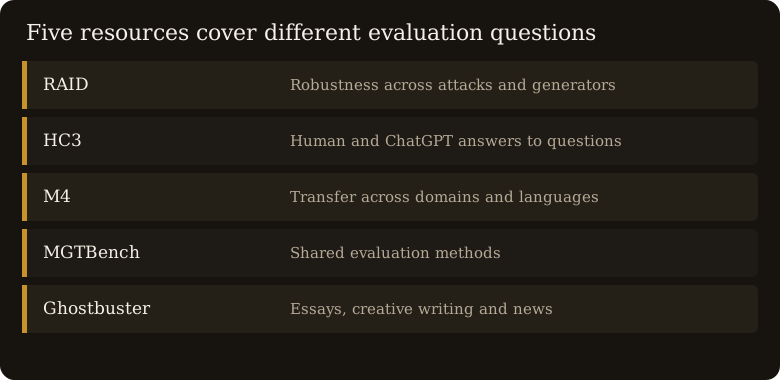
Short answer: AI detection research uses several public benchmarks. RAID tests robustness across models, genres and attacks. HC3 pairs human and ChatGPT answers. M4 tests transfer across languages and domains. MGTBench compares methods under shared settings. Ghostbuster covers essays, creative writing and news. No single dataset proves a detector works on every kind of text.
Which dataset should you use?
| Resource | What it contains | Useful for | Limit to keep in view |
|---|---|---|---|
| RAID | Human and generated text across multiple genres, models, decoding strategies and adversarial attacks | Testing whether a detector remains reliable when the generator or text changes | Its published results describe particular models and attacks, not every model available today |
| HC3 | Human expert and ChatGPT responses to questions across several subject areas | Comparing answers to similar prompts by source | Its AI side is centered on ChatGPT responses collected for the original study |
| M4 | A multi-generator, multi-domain, multilingual corpus | Checking performance outside a detector's familiar language, domain or generator | A result on one split does not establish transfer to all unseen models |
| MGTBench | A benchmark framework and curated generated texts used to compare detection methods | Running methods under a shared evaluation design, including attack tests | Treat the framework, datasets and reported detector results as separate things |
| Ghostbuster | Human and AI text in student essays, creative writing and news | Testing whether performance changes by writing task | Three domains cannot represent every writing context |
The labels in the table describe the authors' published resources, not tests run by poignantguide.net. The study links let readers inspect methods and release details. Dataset sizes and licenses can change across paper versions and repository releases, so consult each project's current repository before downloading or reusing a corpus.
RAID: robustness under changes to text and generation
RAID was designed as a shared benchmark for machine-generated text detection. Its paper reports millions of generations and varies source model, genre, decoding strategy and adversarial manipulation. That design matters because a detector can appear accurate on familiar material yet struggle when text is paraphrased or produced by an unseen generator. The authors evaluated both open and closed detectors and found weaknesses under attacks and distribution changes.
Use RAID when the question is whether a detector's result survives realistic changes to its input. Keep the human and generated partitions, source-document relationships and attack variants straight. If altered copies of the same source appear on both sides of an evaluation split, the result can overstate generalization. Report the detector version, the exact RAID release and split, and the false-positive threshold. A leaderboard score alone does not establish suitability for a school, newsroom or individual authorship decision.
HC3: matched human and ChatGPT answers
HC3, the Human ChatGPT Comparison Corpus, collects responses from human experts and ChatGPT to questions in areas including open-domain, finance, medicine, law and psychology. The pairing makes it useful for examining how answers to related questions differ by source. It is also a snapshot of a particular generation setting. A detector that separates HC3's human answers from its ChatGPT answers might be learning topic, style or collection differences that do not transfer to later tools and other writing tasks.
When using HC3, report whether the test contains full answers or shorter excerpts and whether topics overlap between training and evaluation. For high-stakes claims, inspect false positives on human responses separately. The site methodology explains why a detector score needs a stated test population and threshold.
M4: language, domain and model transfer
The M4 paper introduces a multi-generator, multi-domain and multilingual benchmark. Its central result is a caution about transfer: detectors can misclassify generated text from unfamiliar domains or language models as human writing. That makes M4 relevant when a vendor describes strong performance on a narrow English test but the intended use includes other languages or subjects.
Compare like with like when reading M4 results. A language-specific score, pooled average and unseen-generator score answer different questions. Report the language, source domain, generator and split alongside any metric. Do not apply a pooled result to a person writing in a language or context that was not represented in the test.
MGTBench: an evaluation framework
MGTBench is more than a single pile of labeled examples. Its authors built a framework to compare detection approaches under common settings and studied text attribution as well as binary detection. They also examined paraphrasing, spacing changes and other perturbations. Their reported findings show why an evaluation protocol matters: method rankings can depend on training data, input length and attacks.
If someone cites an “MGTBench score,” ask which method, dataset, attack condition and metric produced it. An accuracy figure without the human false-positive rate can conceal a detector that flags too many genuine authors. The benchmark archive separates published research from any tests actually run by this site.
Ghostbuster: three writing domains
The Ghostbuster paper accompanies a detector with datasets covering student essays, creative writing and news articles. This is useful because those tasks differ in structure, length and voice. A model that performs well on essays may behave differently on news or creative text. The released datasets also let researchers test methods other than Ghostbuster on the same material.
Do not infer that a paper result on these domains applies to every classroom or publishing workflow. Check how the human texts were sourced, how generated texts were prompted, and whether any editing or paraphrasing was included. These details can change the difficulty of the task more than a headline metric suggests.
For evidence about rewritten AI text, read can humanized AI text be detected?
Match the dataset to the claim
| Claim to test | Starting resource | Check before reuse |
|---|---|---|
| Robust to paraphrasing | RAID or MGTBench | Attack variant and split |
| Works beyond one language | M4 | Language and generator coverage |
| Works on student essays | Ghostbuster | Essay source and writing conditions |
| Separates matched answers | HC3 | Question overlap and collection setting |
A practical evaluation checklist
Choose a dataset whose writing resembles the use case. Keep examples from related sources out of both training and test splits. Record the exact dataset and detector versions. State the threshold before inspecting results. Report false positives on human writing, misses on generated writing, and performance by language, topic, text length and attack condition. Preserve enough run information for someone else to reproduce the table.
This page is a guide to published resources. It does not report a new run by poignantguide.net. For the site's criteria, read the methodology. For a research overview, see the research hub. For published detector comparisons and their limitations, see the benchmark archive.
Frequently asked questions
What is the RAID benchmark?
RAID is a shared benchmark for testing machine-generated text detectors across multiple generators, genres, decoding strategies and adversarial attacks. It is especially useful for checking robustness rather than relying on a single familiar test set. Read the RAID paper for the published design.
What is the HC3 dataset?
HC3 is a comparison corpus of human expert and ChatGPT responses to questions across several subjects. It helps researchers examine differences between those response sources, but it does not represent every current model or writing task. Its construction is described in the HC3 paper.
What is Ghostbuster in AI detection research?
Ghostbuster is a text detection method accompanied by human and generated text datasets for student essays, creative writing and news. Those datasets can be used to evaluate other methods too. See the authors' paper.
Is MGTBench the same as M4?
No. MGTBench is a benchmark framework for comparing detection methods under shared settings. M4 is a multi-generator, multi-domain and multilingual corpus. They address related evaluation problems but are separate projects with different authors and releases.
What do “MGTD” and “GRiD” mean here?
“MGTD” is commonly used as an abbreviation for machine-generated text detection, not a uniquely identified dataset. “GRiD” does not identify one of the five resources documented above from the available source material. A benchmark result using either label needs a paper or repository link before it can be compared responsibly.