Published 2026-10-15 | Source review updated 2026-10-15
Short answer: Often, yes. Paraphrasing and humanizer tools can make generated text harder for an existing detector to flag, but they do not make it impossible to detect. Research also shows that detectors trained on rewritten text can recover some of the lost signal. The result depends on the rewrite, detector, text and test conditions.
What a humanizer changes in text
A humanizer rewrites a passage. It may replace words, change sentence order, alter tone, or produce a more extensive paraphrase while trying to preserve the original meaning. Those edits matter because many AI text detectors classify the statistical patterns of the text they receive. A detector does not see the unedited draft unless someone supplies it. It scores the final passage, which may look quite different from the original generated text.
Not every rewrite has the same effect. A few synonym substitutions differ from a new paraphrase with changed structure. A short caption differs from a long essay, and a detector tested on English essays may not behave the same way on technical writing or another language. The question is therefore more precise than whether a humanizer "works": which rewrite was applied, to which text, and against which detector version?
This page reviews published studies rather than claiming that Poignant Guide ran a current head-to-head test. Our methodology explains the records a comparable test would need. The March 2026 benchmark reports results for its ten tested tools. Those scores do not measure the humanizer scenarios reviewed here.
What the research measured
| Study | Rewrite or attack | Detector setting | What the study supports |
|---|---|---|---|
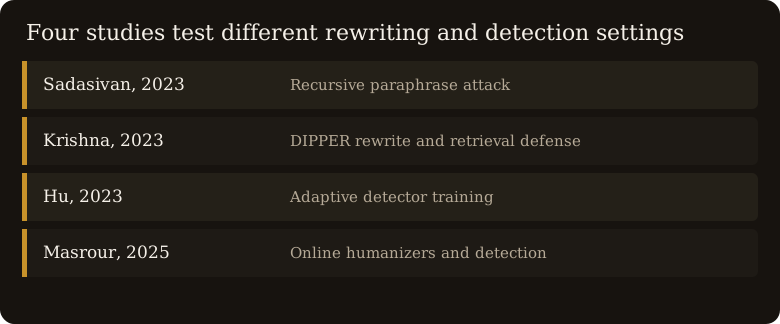
| Sadasivan and colleagues, 2023 | Recursive paraphrasing | Several detection approaches, including watermark and classifier methods | Repeated paraphrasing reduced detection under the authors' attack settings. The paper does not establish that every humanizer beats every detector. |
| Krishna and colleagues, 2023 | DIPPER paraphrases | Multiple detectors plus a retrieval-based defense | Paraphrasing evaded several tested detectors, while a provider-maintained retrieval defense could identify many related generations in its own setup. |
| Hu and colleagues, 2023 | Adversarially trained paraphraser | RADAR detector trained in response to paraphrases | Training a detector against rewritten examples improved robustness in the authors' evaluated conditions. |
| Masrour and colleagues, 2025 | Commercial humanizer and paraphrasing tools | Detectors tested on humanized text, including an augmented model | Many existing detectors missed rewritten text; the authors also demonstrated a detector designed to identify it. |
These studies answer related but different questions. The paraphrase-attack papers control the rewriting method so they can probe detector weaknesses. The DAMAGE paper looks more directly at online humanizer tools and also examines whether rewrites keep the source meaning. None provides a permanent pass rate for a product offered today. Tool versions, model outputs and detectors change, and a result from one test set cannot be carried to every writing setting.
Do detectors adapt to rewritten text?
Yes, researchers have tested ways to adapt. RADAR trains a paraphraser and detector against one another, so the detector learns from examples designed to evade it. DAMAGE uses augmented training data to recognize humanized AI text, including attempts aimed at the authors' own model. Krishna and colleagues explore a different defense: retrieving a previously generated passage that is semantically similar to the submitted rewrite. That approach depends on access to a provider's generation records and is not a general feature of ordinary detector websites.
These defenses matter because a low score from a conventional detector is not a certificate of human authorship. Equally, an adaptive model's success in a paper is not proof that a school or publisher has that model, uses the same threshold, or will obtain the same result on a new passage. A result needs its detector, version, threshold, source text and evaluation setting attached to it.
Why text length and genre change the question
A detector has less evidence in a short passage than in a long one. Rewriting may also remove the exact cues a detector was trained to use while leaving other cues behind. Formal assignments, marketing copy, code comments and creative writing differ in vocabulary and structure. A benchmark built from one kind of text is a poor substitute for a review of another kind.
The published studies above use specified corpora and attacks. A reader should inspect those methods before applying a conclusion to their own document. Ask whether the test used original or edited outputs, how human-written examples were selected, whether non-English text was included, and whether the authors measured false positives. The research archive and buyer guide put these evidence questions in the context of decisions made with a detector score.
What this means for writers and reviewers
For a writer, a humanizer is a rewriting tool. Read its output for altered meaning, fabricated details and a voice that no longer fits the assignment. Follow the rules of the institution, employer or publisher that will receive the text. A lower detector score does not change those rules.
For a reviewer, neither a high nor a low score settles authorship. Preserve the original submission, consider drafts and source notes, and ask for an explanation when context is missing. If a consequential decision is possible, make space for a second human review and a correction. The studies show why an automated label should start a question rather than end one.
Tools in this category include Walter Writes humanizer, with a detector in the same workspace. This identifies a workflow, not a claim that Walter or any other humanizer evades detection.
How to read a humanizer detection claim
| Claim | Record needed before relying on it |
|---|---|
| A detector score fell after rewriting | Original and rewritten passages, detector version, threshold and raw scores |
| Meaning was preserved | Human review criteria and the actual source and output texts |
| A defense recovered detection | Training split, held-out corpus, human false positives and run date |
These are evaluation requirements, not results from this site. A vendor promise without those records cannot establish a general bypass rate.
Frequently asked questions
Can AI still be detected after using a humanizer?
Yes. Humanizing can lower the chance that some detectors flag a passage, but published work also demonstrates detectors trained to recognize rewritten AI text. No study on this page establishes an undetectable tool across all detectors and writing types.
Can an AI humanizer be detected?
Sometimes. DAMAGE studies online humanizer tools and demonstrates a model for recognizing their output in its evaluation setting. That result should not be read as a guarantee for every current product or detector.
Is humanized AI text detectable?
It can be. Detectability depends on the extent of the rewrite, the detector's training and the text being checked. A score from one service is only evidence about that service's classification of that passage.
Can AI detect a humanizer?
Some research systems are designed to identify paraphrased or humanized machine text. Their published evaluations show a possible defense, but they do not tell a reader how every commercial detector performs today.
Is there an undetectable humanizer?
No published study here establishes one. A claim of permanent undetectability would need repeated, independent tests across detectors, texts and dates. Treat any such promise as a marketing claim until its methods and records can be inspected.